|
3 Comments
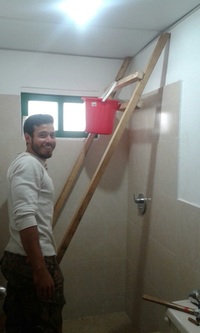
Here's a video I made about a year ago, when I was new to El Gullan. A little bit about the site, its plants and its birds. This was fun (despite it being a <sigh> Bieber song). Feat. tropical snowflakes, sleepy puppy, Doña Rosa, sheepie, and alpacas (llamas?). I wanted to be a pilot, stage actress, psychiatrist, and teacher when I was younger. When you put it down on a CV or in a statement of purpose, your life has to seem like a carefully constructed tapestry. But to you, living your own life, it is usually more of a patchwork quilt of skills and experiences you’ve cobbled together. I never dreamed I’d be studying birds in South America. Well, here I am, my third time in Ecuador, this time for 7 months straight, working on hummingbird physiology, ecology, and behavior in the field. I can finally say I’m hooked. I love it. That’s not to say all this has been easy. I am not a physiologist by training, and it has taken me a long time to feel ownership for my PhD project. But after struggling to get permits, visas, equipment; learning Spanish with no formal training; making mistake after mistake after mistake, and experiencing hummingbirds and the vagaries of the Andes for months on end, I own this, it is mine! As I read somewhere (probably Quora), a PhD is more a test of endurance than of intelligence or specific knowledge- you’ll come out tough and able to handle most of the things the world can throw at you. Field biologists, in addition, have to be adaptable to an extreme degree. I think one of the toughest but most fun parts of it all is learning how to substitute ‘necessary’ comforts with things more readily available in a remote field site. My team and I have built a shower using a holey bucket because water pressure was too low, soldered phone and laptop chargers back together when they broke (no Apple/Motorola/Toshiba store in sight!) and rolled cans of water downhill so we’d have drinking water. We put hot water bags in our beds every night because we don’t have heating, use logs as exercise weights – because who’s going to carry dumbbells on a plane. And always, always, we stand/sit/lie in the weirdest positions to get cell reception on a phone or tablet. All in all, you get to immerse yourself in a new culture, with a new language, new people, without your usual support systems, and somehow make science happen.
How does science happen for me? When I am in Stony Brook, normally for 7/12ths of the year, I sit at a computer and analyze data, write, attend meetings- as do most grad students. In the field, I lead a polar existence. My team and I get up at about 5:15am and go open nets to catch hummingbirds (I am not a morning person, so UGH for the first half hour). Once we catch a bird (we usually use only males, so we don’t disturb possibly nesting females), we bring it back to our station and process it- we record its weight, fix a tiny metal band on its leg to identify it, and take morphological measurements. We then perform an experiment to record some aspect of its physiology- for instance, how its metabolic rate varies with temperature, or how much it can feed maximally, or how much energy it consumes to hover; and then we let it go. We then spend the rest of the day putting up cameras at flowers (to see which birds use which flowers to get energy), collecting nectar data from flowers, or recording hummingbird behavior. In the evenings, we usually net for birds again and run an experiment all night to see how much energy the birds use at night.
Fun fact: Hummingbirds, like some small mammals, can go into torpor at night- this means they switch from maintaining a constant body temperature, like us endotherms do, to being like ectotherms- like lizards- which allow the environment to determine their body temperature. This saves them a significant amount of thermoregulatory energy at night. So we record their energy use all night to see how the use of torpor changes for different species and temperatures. Why do I do all this? My immediate goal is to make an energy budget using birds in their natural environment. This energy budget is a model of how much energy these birds spend on what, to understand what factors (e.g. temperature, flower availability, other hummingbirds) influence hummingbird energy use. The ultimate goal is to predict what a species would do in a range of conditions- for instance when temperatures rise further with climate change, or if resources decrease due to habitat destruction. Hummingbirds are tiny, and run out of energy very quickly because they hardly store any fat. So if we understand how they manage their tight energy budgets, we can work up to more complicated energy budgets in other organisms. I’m quite happy with how my patchwork quilt is shaping up, and excited to see what other field adventures the future holds. Along the way, I hope to get as many people as I can interested in field biology and ecology as I can! This article was just published in Stony Brook's GWiSE (Graduate women in science and engineering) newsletter. Join GWiSE if you are interested in interacting with other graduate women and getting involved with mentoring and community outreach! 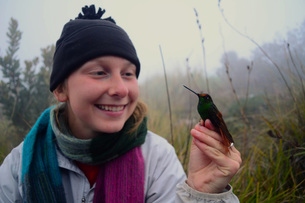 My name is Julisa Ricart, and as you may have seen in an earlier blog post, I am one of Anusha’s assistants for this field season! I’m an undergraduate student at the University of Wisconsin – Madison. This is my first time working as a field research assistant and also my first time working outside of the United States. I’m coming up on my 4-month mark of being here in Ecuador, and I’ve learned a lot! Although I’m sure I have so much more to learn, I thought I’d share a few pointers for first-time field assistants.
When applying for field assistant positions... 1) Don’t be too picky about what you’re studying; be picky about who you’re working with. I internet-stalked Anusha extensively before deciding to apply, and I really wanted to work with her because of her enthusiasm for teaching. In your interview, make sure to get a good feel for how your supervisor runs a team, their expectations, and responsibilities you’ll have. The help that I received applying for a Visa, booking a hostel, getting a cab when I arrived, etc. said a lot about how much Anusha cares about her field team before I even met her. Honestly, I never thought I would end up working with birds, but now that I have, I really like it! I am learning many things that I never knew about physiology, ecology, the scientific method, and working in a team that are applicable in areas other than ornithology. I’m glad my decision was based more on working with Anusha than on what she studies. If you’re deciding between college and the field for a semester… 2) Choose the field. I’m so happy I did. Plus, your school may even have ways you can earn internship/independent study/study abroad credit for working as a field assistant. (This does require a bit of planning, so the moment you think you might be taking off for a semester – talk to your advisor!) School will be there for you when you return. If you take my advice from #14, you’ll learn a lot more in the field than you would’ve at a semester of school anyway! My experiences here are completely invaluable and will shape which classes I will take, the contacts I will make, and the experiences I will gain during the rest of my undergraduate career. When packing… 3) You will over pack, but you won’t bring enough socks. You’ll never bring enough socks. If you’re like me and my coworkers, you might have to wear the same outfit for many, many days in a row. Bringing 1,000 t-shirts isn’t useful. You’ll end up wearing your favorite 3 the entire time. You will, however, run out of socks. I would estimate a good number of socks to bring would be the number of socks you’re planning on bringing multiplied by 3*. Also, bring black socks. Your white socks will turn interesting shades of brown. I think it’s safe to say I’ll be tossing the majority of my socks before I return to the states. #n0ob * Disclaimer: Just a rough estimate. It might be impossible to bring enough socks. I’ll have to reevaluate this after my next field position. 4) Bring camouflage/neutral colored clothing. You know what the University of Wisconsin’s school color is? Bright red. You know what color hummingbirds are attracted to? Bright red. My bad. Go Badgers. 5) If flying, don’t put your pocket knife in your carry-on. I repeat: DO NOT PUT YOUR POCKET KNIFE IN YOUR CARRY-ON. You will end up not having a pocket knife. The TSA will end up having your pocket knife. They also took my insect-kill jar from my checked luggage. Apparently bringing cyanide on an airplane is NOT cool. Or maybe it was because it had “KILL JAR DANGER CONTAINS CYANIDE” written all over it...? Anyone working for the TSA comment below and help a sista out. 6) Prepare for the worst, hope for the best. You might think you’ll have running water the entire time, but anything can happen. I’m very thankful that I brought dry shampoo and soap that doesn’t require water. 7) Bring the Essentials: Watch (that shows seconds), waterproof rain jacket (don’t leave this in a club in Quito…*cough*JOSHUA*cough*), pocket knife, comfy shoes, chargers, pens/pencils, hat, favorite candy, tea, camera, a good playlist, an outfit to wear around civilization (not just field clothes – showing up to salsa dancing in hiking boots and camo is also a no-go), zip-lock bags, medicines + first aid, TUMS (LOTS OF TUMS), gloves, towel, thermos, field backpack, headlamp. Don’t Bring the Non-Essentials: Soap/Toothpaste/Shampoo/etc. (99% sure you can buy this when you get there, no matter where you are), a TV (I’ve heard horror stories), hair dryer, books (Bring E-books instead!), anything you can live without. When working internationally… 8) Make sure you can flush toilet paper down the toilet in the country you are traveling to. In Ecuador, you cannot. I found this out the hard way when my pee started clogging the toilet. 9) Remember you will be immersed in a different culture. Especially if you have local co-workers. It’s important to be culturally empathetic when communicating with international coworkers, because some of things they do or say may offend you, but may just be because of their cultural norms. Also be prepared to learn a lot scientifically from your local co-workers. They know the most about the environment you’ll be working in! 10) You will get homesick. This is normal and temporary. Just try to remember you’re only in the field for a relatively short time, so cherish it while you can! (And call home once in a while! Hi mom.) When on the job… 11) Bring toilet paper and water into the field. ‘nuff said. 12) This isn’t a 9-5 job. Schedules are practically useless and very weather dependent. Get ready to be SUPER TIRED at some points. You may have to collect data at 2:55 AM and then go catch birds in the wee hours of the morning. Other days you might just have to sit around and enter data. If the person who’s leading the project is a human and needs sleep as well, you will likely have a good balance of this. But if they are super-human and seem to never tire, don’t be afraid to speak up and say that you’re not. Sleep-collecting data is not good for either of you! 13) Prepare to live, work, and play with your co-workers. Mentally prepare to be isolated with the same few people for however long the field season is. Spending all of your time with the same people comes with its advantages and disadvantages. You’ll get VERY comfortable with them (sometimes too comfortable… Josh, please stop announcing your belches, thanks.), and they’ll end up being great resources. Being the youngest on the team, it’s been enlightening to see Anusha work on her PhD, Josh begin to apply to PhD programs, Anita work post-graduation, among other things. For me, these people have become great co-workers, mentors, wonderful friends, travel buddies, and salsa partners. 14) Take charge of how much you learn in the field. Know that your job description is to essentially be a data-collection monkey, BUT you don’t have to be a mindless data-collection monkey if you don’t want to be. Ask questions and really understand why you’re collecting the data; an understanding helps you learn more. Ask for independent projects or to take on larger responsibilities such as analyzing data. This won’t always be possible, but it doesn’t hurt to ask. The person who is leading the study is likely the expert in their field; learning from them is a once in a life time opportunity! So hopefully from these few pointers, you can avoid getting your pocket knife taken away, apply for enriching field experiences, and learn the most that you can from a field experience! Comment below if you have any other pointers for me and other field work newbies. Cheers, Julisa I'm making an energy budget for hummingbirds. What is that, you ask? You know, like you have a financial analyst (if you are rich enough to have money, not if you are a grad student) to budget your money and tell you how much you're spending on what- I do that with hummingbirds' energy use. I measure how much energy hummingbirds use to do things like perch, fly, and keep themselves warm. The idea is to see how this energy budgeting changes with outside temperature and with the energy available to them in their habitats. If there are a lot of flowers available to them to feed on, do they spend more energy because they can, or less because they don't have to search much for food any more? If it gets warmer, do they have to spend so much energy cooling down that they can't go find a mate, or can't defend a territory? Can you guess where this is going? Climate change! As temperatures change, will hummingbirds, and other animals, suffer energetically? Will their energy budgets become so tight that they can't survive? These are some of the questions I'm asking with my dissertation work. Some components of this work include: 1. Measuring the thermoneutral zone (TNZ) of different hummingbird species. Here is a simple sketch of what the TNZ is. A species' TNZ is the range of outside temperatures within which it does not have to spend much energy maintaining its body temperature. At lower and higher temperatures, things start to get more expensive. Have you noticed how you tend to either get thinner when it's a cold winter, or you eat a lot more? That's because your body has to spend more energy keeping itself at normal body temperature. Generating heat is expensive!  2. Recording behavior. This is good old ecology- we spend a lot of time in the field writing down just what hummingbirds do and for how long. It looks something like this: 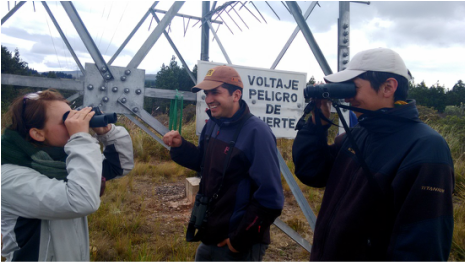 Julisa, Boris, Pedro (Hormiga) Ok, no actually it looks like this: 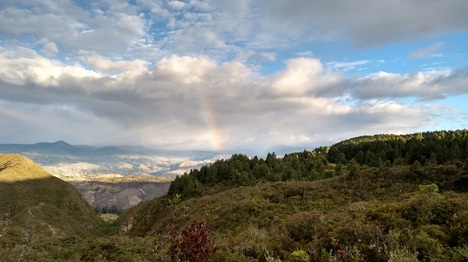 View from a behavior point 3. Putting cameras on flowers. Taking a flower out of Ben's book, we put cameras on flowers we believe are hummingbird visited, to see how often a hummingbird species visits a particular flower species. It's a bit of a struggle putting them up sometimes, but we get some great captures from the cameras.
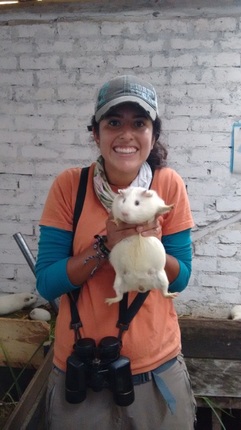
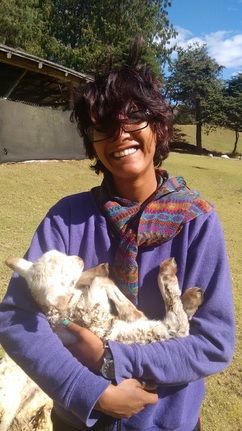
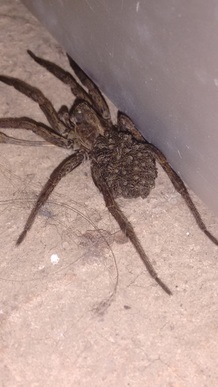
4. We get to interact with random farm animals. The list so far includes- dogs, cat, alpacas, sheep, lambs, guinea pigs. This is, of course, apart from the not-so-tame animals- the birds, spiders and their babies, beetles, praying mantises, bees, lizards, skinks, frogs, and so on.
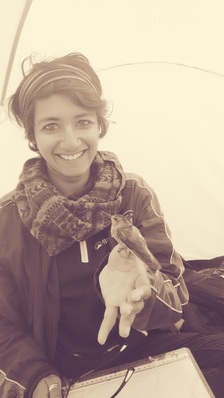
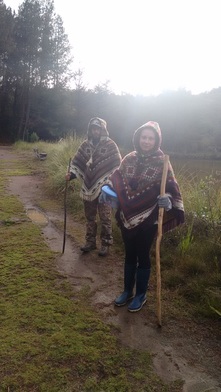
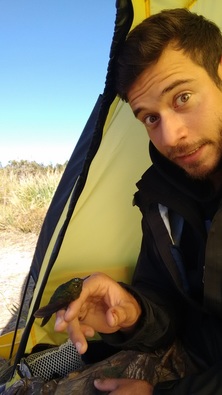
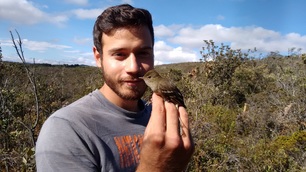
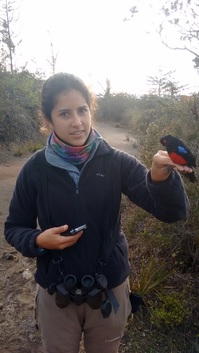
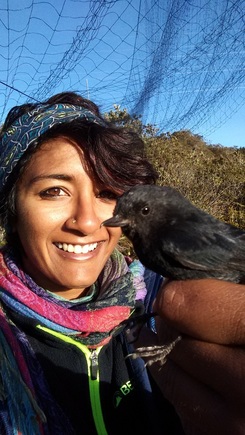
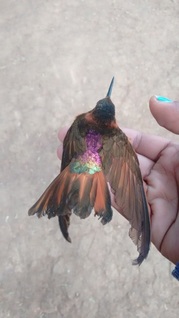
5. We also, incidentally, work with hummingbirds. And get to see other birds up close. Here's some bird photos and other fun photos!
An introduction and a welcome
|
Anusha ShankarPostdoc, Nat Geo Explorer, hummingbird physiology and ecology. Archives
March 2019
Categories |






 RSS Feed
